
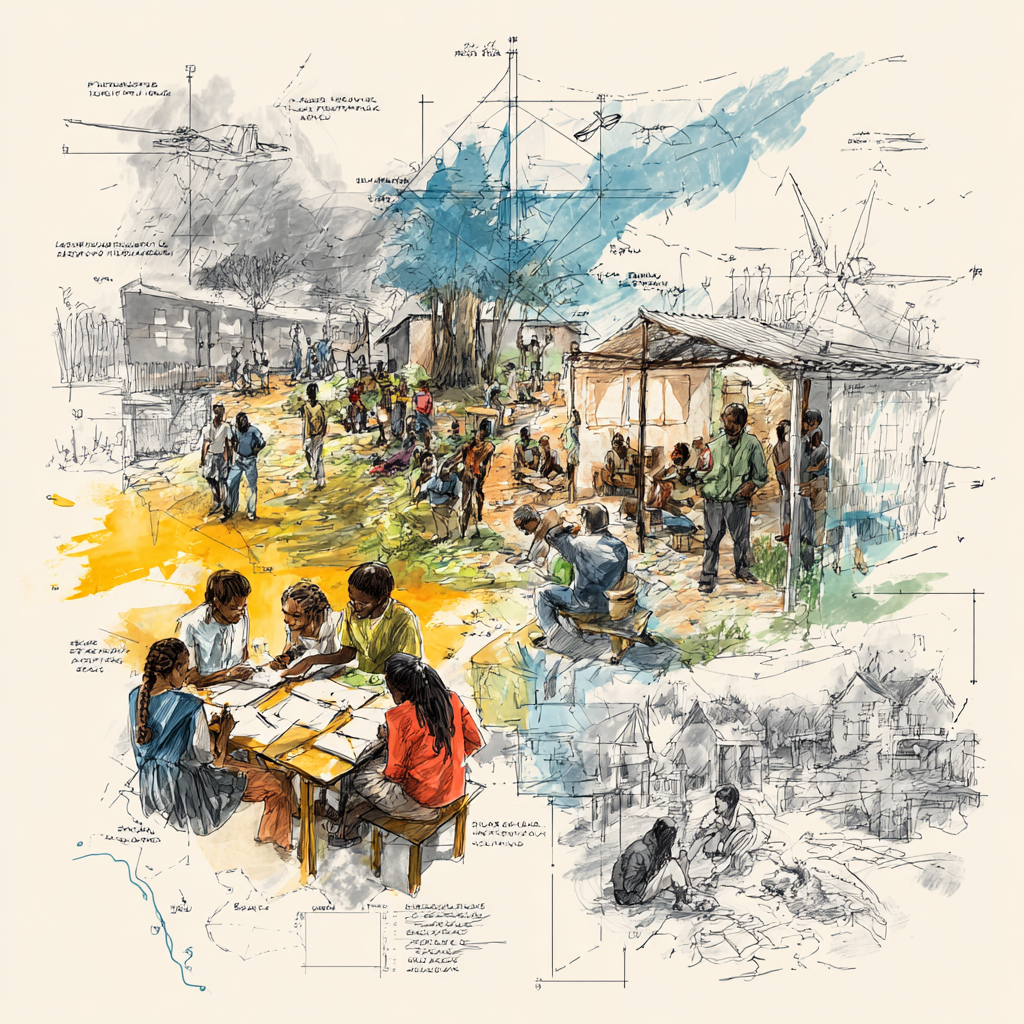
Educators are increasingly confronted with situations where the traditional classroom simply does not exist. Whether due to community displacement, infrastructural collapse, or chronic resource scarcity, learning often begins in open fields, temporary shelters, village squares, or even in the quiet corners of daily life. These realities challenge us to reconsider what makes education possible in the first place. When we strip away walls, desks, and formal routines, we begin to see the fundamental forces that actually initiate learning, and those forces have more to do with relationships, autonomy, and shared purpose than physical space.
Research in situated learning and ecological psychology consistently tells us that learning is not a place-bound activity, but a relational one. A classroom merely organizes interactions: between teacher and students, between students and peers, and between learners and ideas. When space disappears, these interactions must reorganize themselves, often in surprisingly adaptive ways. In environments where there is no defined classroom, students tend to rely more heavily on community norms, peer scaffolding, and intrinsic curiosity. This does not mean that traditional structures are unnecessary, but rather that meaningful learning can survive without them if the right conditions are intentionally cultivated.
Several principles emerge when educators design learning experiences without a formal classroom.
- Shift from space-centered to interaction-centered design.
Instead of asking “Where will the lesson take place?”, ask “What interactions do learners need to develop this understanding?”
Removing the physical classroom highlights the centrality of shared attention, dialogue, and collaborative meaning-making. - Clarify autonomy to strengthen engagement.
In nontraditional environments, students rely more on self-direction. Educators can support this by:- providing simple, structured choices
- defining clear expectations
- building routines that travel with the learner, not the location
- Lean into the cultural and communal assets available.
A shaded tree, a community hall, or a marketplace offers authentic learning cues. These real-world contexts become catalysts for curiosity when used purposefully. - Redefine the teacher’s role as facilitator rather than controller.
Without the classroom’s physical authority, teachers’ relational authority becomes more important. Guiding inquiry, moderating discussions, and modeling reasoning hold more influence than directing posture and seating.
One concrete example comes from a rural learning project in Southeast Asia. With no formal school building and only intermittent access to materials, educators created “learning circles” under a community pavilion. Students rotated leadership roles each week, using locally relevant problems such as water distribution or crop planning as anchors for mathematics and science discussions. Without walls, learning became a shared communal event rather than an isolated academic task. Engagement increased, absenteeism dropped, and parents began participating in discussions organically. This transformation was not the result of clever improvised materials, but of educators centering learning on interaction, autonomy, and community knowledge.
Educators working in these environments may find it useful to pause and reflect:
What is the minimum structure learners need in order to think deeply?
How can I support autonomy without overwhelming students?
Which community resources or cultural practices could be integrated naturally into lessons?
If my classroom vanished tomorrow, what parts of my teaching would still remain?
These questions reveal something essential. We often assume that the classroom is the foundation of learning, but in practice, learning begins long before the classroom and continues long after it. When space becomes uncertain, educators are pushed to anchor learning in what truly matters: purposeful relationships, intellectual curiosity, and shared problem solving.
The future of education will not be defined solely by furnished rooms or digital platforms, but by our ability to create learning ecologies that survive and adapt regardless of physical constraints. As mobility increases, crises recur, and communities reorganize themselves, educators who can design resilient learning environments will shape the next generation’s capacity to grow under any circumstance. When we learn to teach beyond the classroom, we help students learn beyond limitation.Educators are increasingly confronted with situations where the traditional classroom simply does not exist. Whether due to community displacement, infrastructural collapse, or chronic resource scarcity, learning often begins in open fields, temporary shelters, village squares, or even in the quiet corners of daily life. These realities challenge us to reconsider what makes education possible in the first place. When we strip away walls, desks, and formal routines, we begin to see the fundamental forces that actually initiate learning, and those forces have more to do with relationships, autonomy, and shared purpose than physical space.
Research in situated learning and ecological psychology consistently tells us that learning is not a place-bound activity, but a relational one. A classroom merely organizes interactions: between teacher and students, between students and peers, and between learners and ideas. When space disappears, these interactions must reorganize themselves, often in surprisingly adaptive ways. In environments where there is no defined classroom, students tend to rely more heavily on community norms, peer scaffolding, and intrinsic curiosity. This does not mean that traditional structures are unnecessary, but rather that meaningful learning can survive without them if the right conditions are intentionally cultivated.
Several principles emerge when educators design learning experiences without a formal classroom.
- Shift from space-centered to interaction-centered design.
Instead of asking “Where will the lesson take place?”, ask “What interactions do learners need to develop this understanding?”
Removing the physical classroom highlights the centrality of shared attention, dialogue, and collaborative meaning-making. - Clarify autonomy to strengthen engagement.
In nontraditional environments, students rely more on self-direction. Educators can support this by:- providing simple, structured choices
- defining clear expectations
- building routines that travel with the learner, not the location
- Lean into the cultural and communal assets available.
A shaded tree, a community hall, or a marketplace offers authentic learning cues. These real-world contexts become catalysts for curiosity when used purposefully. - Redefine the teacher’s role as facilitator rather than controller.
Without the classroom’s physical authority, teachers’ relational authority becomes more important. Guiding inquiry, moderating discussions, and modeling reasoning hold more influence than directing posture and seating.
One concrete example comes from a rural learning project in Southeast Asia. With no formal school building and only intermittent access to materials, educators created “learning circles” under a community pavilion. Students rotated leadership roles each week, using locally relevant problems such as water distribution or crop planning as anchors for mathematics and science discussions. Without walls, learning became a shared communal event rather than an isolated academic task. Engagement increased, absenteeism dropped, and parents began participating in discussions organically. This transformation was not the result of clever improvised materials, but of educators centering learning on interaction, autonomy, and community knowledge.
Educators working in these environments may find it useful to pause and reflect:
What is the minimum structure learners need in order to think deeply?
How can I support autonomy without overwhelming students?
Which community resources or cultural practices could be integrated naturally into lessons?
If my classroom vanished tomorrow, what parts of my teaching would still remain?
These questions reveal something essential. We often assume that the classroom is the foundation of learning, but in practice, learning begins long before the classroom and continues long after it. When space becomes uncertain, educators are pushed to anchor learning in what truly matters: purposeful relationships, intellectual curiosity, and shared problem solving.
The future of education will not be defined solely by furnished rooms or digital platforms, but by our ability to create learning ecologies that survive and adapt regardless of physical constraints. As mobility increases, crises recur, and communities reorganize themselves, educators who can design resilient learning environments will shape the next generation’s capacity to grow under any circumstance. When we learn to teach beyond the classroom, we help students learn beyond limitation.
[ To Fathom Your Own Ego, EGOfathomin ]