
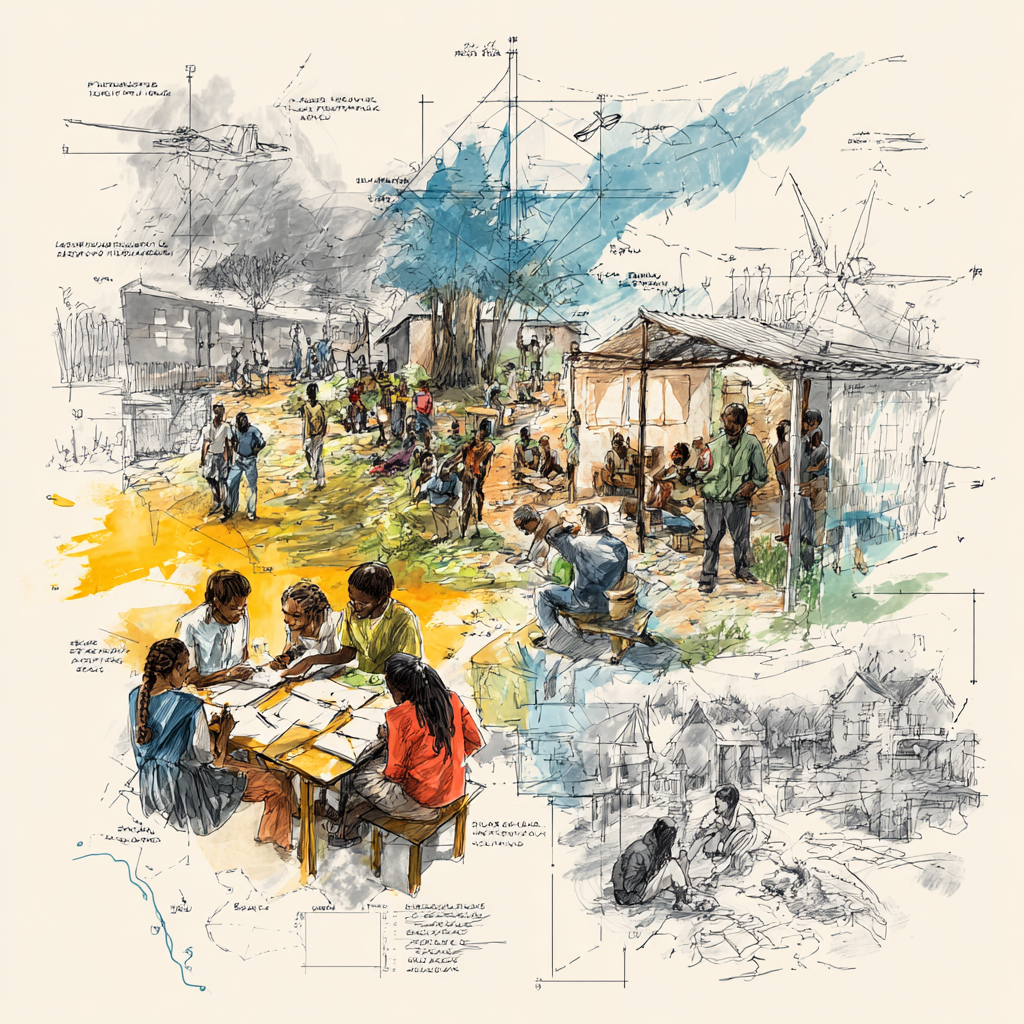
In many schools and learning spaces today, abundance has become the default. Screens multiply, platforms stack, materials overflow, and well-intentioned support systems quietly compete for learners’ attention. Yet, in some of the most constrained environments, remote classrooms, temporary learning shelters, or under-resourced schools, educators often observe a surprising phenomenon: deeper focus, stronger persistence, and a more authentic form of engagement. This is not accidental. It reveals a core truth about how attention, autonomy, and metacognition actually function when learning infrastructure is stripped to its essentials.
This topic matters now because education systems are at a crossroads. As investment in technology accelerates, so does cognitive overload. Understanding why minimal learning environments can trigger intense immersion is essential for educators who want to design learning experiences that cultivate depth rather than distraction.
The Educational Principle Behind Simplicity and Focus
At the heart of this phenomenon lies what cognitive psychology often describes as the simplicity effect. Human attention is a finite resource. When learners are surrounded by excessive stimuli, visual cues, tools, notifications, choices, and options, their cognitive load increases before learning even begins.
Research on attention and working memory consistently shows that reducing extraneous input improves task persistence and comprehension. When fewer elements demand attention, learners allocate more mental energy to meaning-making, monitoring understanding, and regulating effort. In other words, minimal infrastructure lowers the cost of entry into focus.
Equally important is autonomy. Sparse environments force learners to make more decisions about how to engage. Without constant prompts or automated scaffolds, students must decide what matters, when to pause, and how to proceed. This activates metacognitive processes, such as self-monitoring, goal clarification, and error detection, that are often underdeveloped in overly guided environments.
Finally, simplicity reshapes the emotional climate of learning. Fewer tools reduce performance anxiety. Learners feel less observed, less interrupted, and more psychologically safe to remain with a problem longer. This emotional quiet is a prerequisite for sustained concentration.
Why Minimal Infrastructure Enhances Immersion
The relationship between infrastructure and immersion is not linear. More resources do not automatically produce better learning. In fact, minimal environments support immersion through three mechanisms.
First, attention narrowing. When options are limited, attention stabilizes. Learners are less tempted to switch tasks or seek novelty.
Second, ownership of process. Without step-by-step digital guidance, learners experience the learning process as something they actively manage rather than consume. This strengthens agency.
Third, metacognitive visibility. In simple settings, confusion is harder to hide. Learners become more aware of what they do and do not understand, which is a critical condition for deep learning.
Practical Applications for Educators
Minimal learning environments do not require removing all tools. They require intentional subtraction. The following applications can be implemented in both high-resource and low-resource settings.
- Design single-focus sessions
Plan lessons around one clear cognitive objective. Remove secondary tasks, optional extensions, and parallel activities. Allow learners to stay with one problem or question longer than usual. - Limit instructional artifacts
Use fewer slides, fewer handouts, and fewer platforms per session. Ask whether each material directly supports the learning goal or merely decorates it. - Create device-free intervals
Even in technology-rich classrooms, designate periods where learners work only with paper, voice, or mental rehearsal. This sharpens internal regulation. - Replace prompts with pauses
Instead of constant guidance, build structured silence into lessons. Pauses invite learners to reflect, predict, and self-correct. - Encourage learner-generated structure
Ask students to outline their own approach before providing models. This reinforces planning and monitoring skills. - Normalize productive struggle
In minimal settings, confusion is expected. Frame uncertainty as a signal for thinking, not a failure of instruction.
A Real-World Example
Several years ago, a rural learning center faced an unexpected challenge. A power outage eliminated access to digital tools for several weeks. Teachers initially worried about lost progress. Instead, they observed a shift. Students spent longer periods on reading and problem-solving tasks. Discussions became slower but deeper. Learners began articulating where they were stuck without waiting for prompts.
When electricity returned, many teachers chose to preserve elements of the low-infrastructure routine. They had seen that fewer tools did not limit learning. It clarified it.
Reflection Questions for Educators
As you consider your own learning environments, the following questions may be useful.
- Which elements in my classroom compete for attention rather than support it?
- Where might reducing tools increase learner ownership of the process?
- How often do my students experience uninterrupted thinking time?
- Do my instructional supports encourage dependence or self-regulation?
- What would happen if one lesson per week were intentionally simplified?
Concluding Insight and Forward Perspective
Minimal learning infrastructure does not romanticize scarcity. It reframes focus as a design choice rather than a byproduct of resources. The goal is not to reject technology, but to understand when subtraction strengthens cognition.
As educators, our task is not to fill every gap with tools, but to create conditions where learners can meet themselves in the act of thinking. In an era defined by educational abundance, the capacity to design for simplicity may become one of the most advanced professional skills we can develop.
The future of effective learning may not depend on how much we add, but on how carefully we decide what to leave out.
[ To Fathom Your Own Ego, EGOfathomin ]